AI SEARCH OPTIMIZATION IS CHANGING HOW WEBSITES GET FOUND
Search visibility is no longer only about ranking well. A page also needs to make its meaning easy to understand, extract and reuse, which makes content structure a design problem too.
AI search changes visibility from a ranking problem into an understanding problem. I now look at content structure as part of search performance because a page has to make sense even when the interface is not the thing being read.
JUMP TO
Visibility now depends on whether systems can understand the page.
For years, search was fairly easy to describe. Build a technically sound website, target the searches that matter, earn authority and try to move higher in the results. I still think those things matter. I just no longer think they describe the whole problem. AI search adds another layer between a website and the person looking for an answer. A system may read several sources, combine what it finds and return a useful response before the user opens any of those pages.
I have started using a simple test when I review content: if the interface disappeared, would the meaning of the page still be obvious? A heading like 'Our Approach' can look perfectly fine inside a polished layout and still say almost nothing on its own. The same problem appears when one elegant paragraph carries five different ideas. A person can use visual context to piece it together. An AI system has to reconstruct the structure first. Ranking still matters, but being understandable is becoming part of visibility too.
Visual clarity does not guarantee structural clarity.
The topic became more useful to me when I stopped treating it as an SEO discussion. While shaping AI Search Optimization work at Kiwistic, the first questions were not about adding more keywords. We were looking at headings, page sections, questions and the order in which an answer appears. A service page can be visually clean while the information underneath is poorly separated. One block might cover the service, process, response time and what happens when something goes wrong. The layout holds it together, but the meaning is doing too much work.
A WordPress maintenance page is a good example. Someone whose site keeps breaking after plugin updates does not need six repetitions of 'WordPress maintenance'. They want to know whether updates are tested, whether backups exist, what happens if something breaks and how quickly someone responds. I would rather give those questions a clear place in the structure. Not because an algorithm prefers short blocks. Because the page becomes easier to scan and individual answers can stand on their own when they appear outside the original interface.
Information architecture now travels beyond the interface.
I do not think designers suddenly need to become SEO specialists. I do think we need to care more about what happens to information after it leaves the screen we designed. Modular sections, useful headings and predictable content patterns already help people understand complex pages. They also create clearer boundaries between ideas. A question such as 'What happens after I submit a project request?' can be buried inside a generic process paragraph, hidden behind a vague accordion label or answered directly under a heading that says exactly what the section is about. All three can look acceptable in Figma. They are not equally clear once the visual context disappears.
Design systems matter for the same reason. If every page invents a different way to explain the same kind of information, maintenance gets harder and meaning becomes less predictable. I am not arguing for rigid templates. Some pages need more freedom. But repeated information should have a recognizable structure. A service definition should behave like a service definition. A process step should not turn into a marketing banner because there was empty space in the layout. Good structure makes the interface easier to use, and it gives search systems less guessing to do.
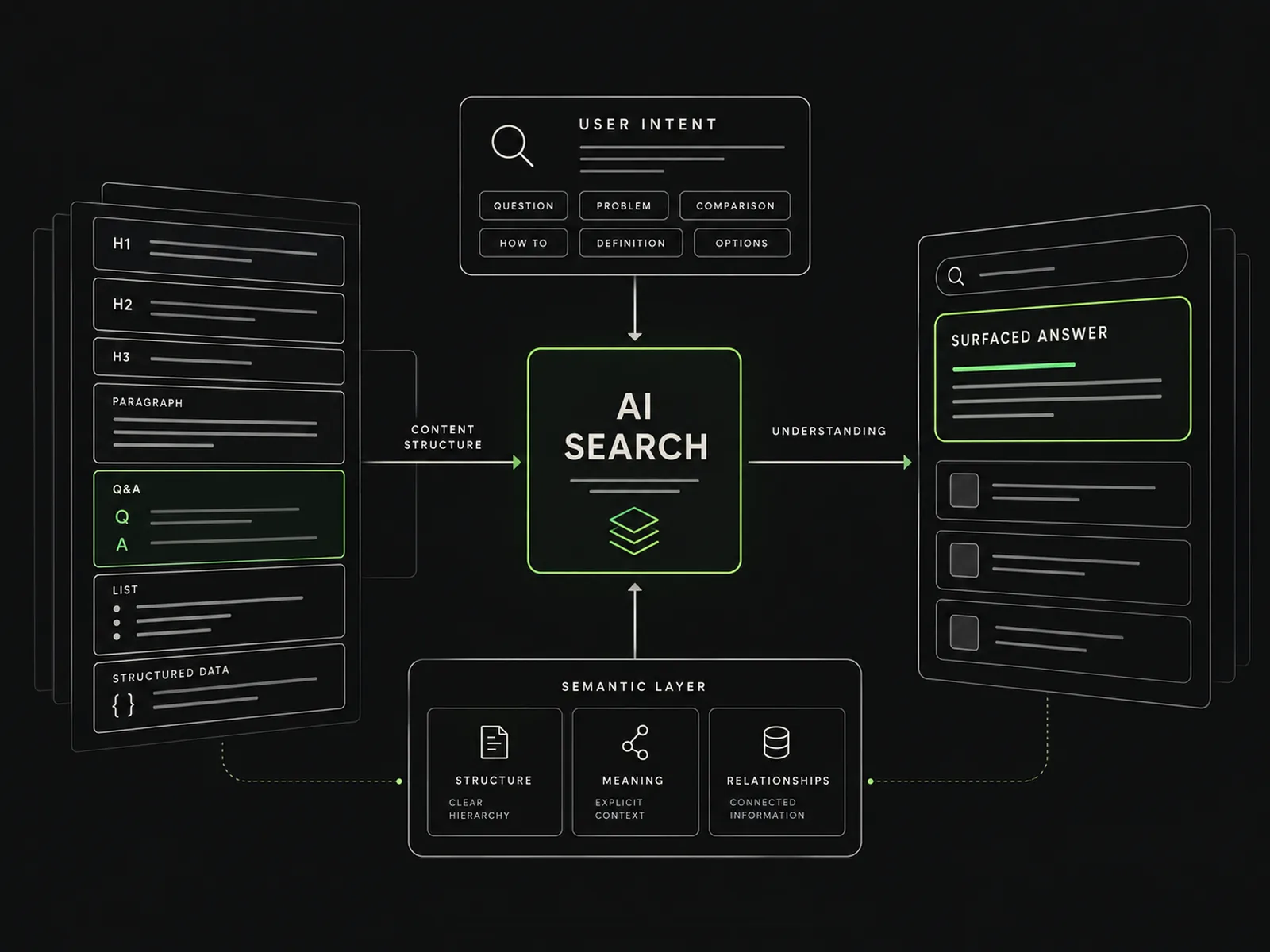
VISIBILITY = INTENT + STRUCTURE + EXPLICIT MEANINGI would rather build around the question than the query.
My starting point now is the question a person is trying to answer. What brought them to the page? What do they need to know before they can make a decision? What evidence or detail removes uncertainty? Those questions create a stronger structure than a keyword list. Keywords still have a job, but they should support the experience rather than define the architecture. When the content is organized around intent, the language usually becomes more specific as a side effect. The page starts answering real questions instead of performing relevance.
I also trust that approach more than trying to reverse-engineer every AI search product. The platforms will change. Their preferred formats will change with them. Clear questions, specific answers and sensible information hierarchy are less fragile. Someone may reach the page through Google, an AI-generated answer or a link from a colleague. The discovery layer can move around. The underlying need is much more stable. I would rather design for that stable part of the problem than spend the next year chasing another algorithm.
CLOSING SIGNAL
I do not see AI Search Optimization as a replacement for SEO. I see it as another reason to stop treating content as something we pour into a finished layout. The structure of the information is part of the product. When the hierarchy is weak, people work harder and AI systems have to guess more. When the meaning is explicit, both have an easier job. For me, that is the useful part of the shift. I am not interested in designing pages for robots. I am interested in designing pages where the important information still makes sense when someone does not see exactly what I saw in Figma.