WHY 43% OF THE WEB RUNS ON WORDPRESS – AND WHY THAT NUMBER KEEPS GROWING
WordPress keeps growing not because it is the cleanest platform, but because it solves an unusually broad set of problems while an enormous ecosystem keeps reinforcing its value.
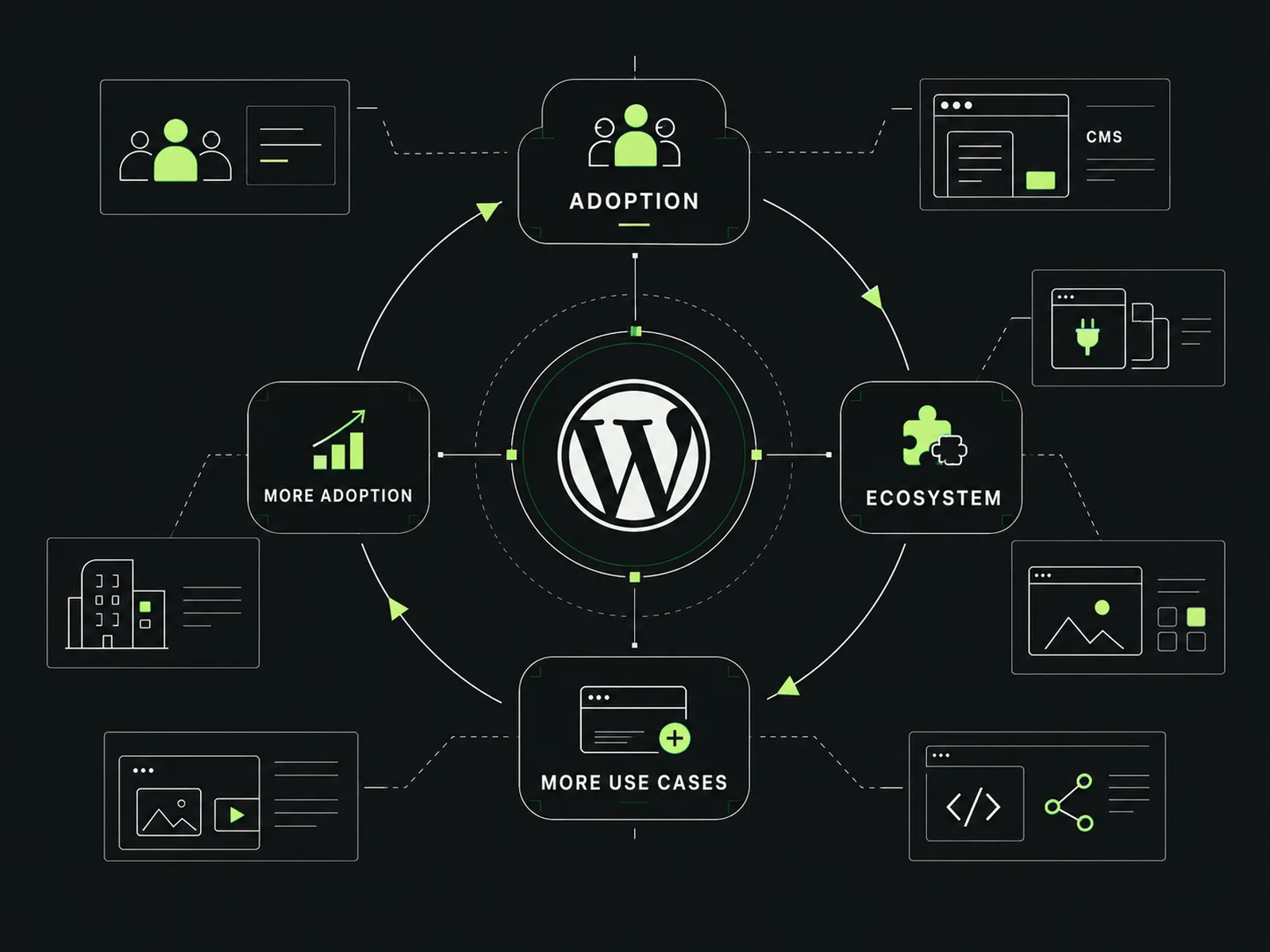
WordPress keeps expanding because it covers an unusually wide range of real-world needs. Its ecosystem then turns that usefulness into familiarity, and familiarity into a self-reinforcing adoption loop.
JUMP TO
The most successful product is not always the cleanest one.
WordPress powers a huge part of the web, and by 2026 it is still growing in a market that has no shortage of newer, cleaner and more fashionable alternatives. That is what makes the story interesting. The question is not how WordPress became dominant. The more useful question is why it keeps holding that position while the tools around it keep changing.
From a product perspective, dominance is rarely the same thing as perfection. WordPress is not the cleanest system, the most consistent interface or the easiest platform to explain to a first-time user. Different themes, plugins and builders can create very different experiences. Yet those imperfections have not stopped adoption, because products are not chosen in a vacuum. They are chosen against budgets, skills, timelines, existing workflows and the cost of changing what already works.
That is where WordPress has an unusual advantage: it solves an extremely wide range of problems. A freelancer can launch a small site with it. A marketing team can manage content without waiting for developers. An agency can build repeatable client systems. A larger business can use it as part of a much more complex stack. It does not need to be the best tool in every one of those situations. It only needs to remain useful enough across all of them.
Choosing WordPress means choosing much more than the CMS.
The more important product is not WordPress core on its own. It is the ecosystem around it. Themes, plugins, builders, hosting platforms, integrations, agencies and specialist developers extend what the platform can do far beyond the base CMS. Choosing WordPress often means choosing access to that surrounding system.
That changes the value equation. A feature that is missing from the core product may already exist as a mature plugin. A design team may already know a builder that fits its workflow. A business may already have hosting, analytics, commerce, translation or CRM tools that connect to the same platform. The ecosystem reduces the distance between a requirement and a workable solution.
It also creates a form of lock-in that has less to do with proprietary technology and more to do with accumulated familiarity. People know where things are. Teams have processes around publishing and maintenance. Agencies have reusable patterns. Developers know the common failure points. Businesses know they can find support. Replacing all of that requires more than finding a technically better CMS.
At scale, familiarity becomes a network effect.
Familiarity is easy to underestimate because it rarely appears on a feature comparison table. In real projects, however, it reduces risk. A known platform means a larger hiring pool, more documentation, more existing integrations and fewer completely new decisions. For a business, that can matter more than having the newest interface or the most elegant architecture.
At WordPress scale, that familiarity starts to compound. More users create more demand for plugins, services and integrations. More tools make the platform useful for more kinds of projects. More use cases bring in more users. The result is a self-reinforcing loop: adoption grows the ecosystem, and the ecosystem makes further adoption easier.
This is why market position becomes difficult to attack with features alone. A new platform can be faster, simpler or more modern and still face a much bigger problem: it has to replace not only a CMS, but also years of habits, available expertise, extensions and business confidence. WordPress does not need to win every direct comparison to keep benefiting from that network effect.
PLATFORM VALUE = CORE + ECOSYSTEM + FAMILIARITY + ADAPTABILITYThe future is less about leaving WordPress and more about using it differently.
None of this means WordPress is standing still. The way it is used is changing. More teams are separating content from presentation, paying closer attention to performance, using structured content more deliberately and combining WordPress with modern front-end frameworks or headless architectures.
That matters because it changes what the platform has to be. WordPress does not always need to own the full experience from database to rendered page. In some systems it can be the familiar editorial layer while other technologies handle the front end, search, commerce or application logic. That lets teams keep the part of the platform that solves a real organizational problem without forcing every part of the product into the traditional WordPress model.
The same shift is visible in more conventional builds too. Better hosting, stronger caching, leaner themes, more disciplined plugin choices and performance-focused development are changing the gap between what WordPress used to feel like and what a well-built WordPress product can be today. The platform is not escaping its history; it is learning how to fit into a more demanding web.
CLOSING SIGNAL
The interesting part is not simply that WordPress has a large market share. It is that its position keeps revealing a basic product lesson: relevance can be more durable than elegance. A platform that covers many real-world needs, supports a large ecosystem and adapts without forcing its users to start again has a strong reason to remain in the market. For designers and product teams, that is worth paying attention to. The best solution is not always the newest one or the one with the cleanest demo. Sometimes the stronger product is the one that understands where people already are, what they already know and how much change they are realistically willing to absorb.