AI IS CHANGING THE DESIGNER’S ROLE FROM MAKING TO DIRECTING
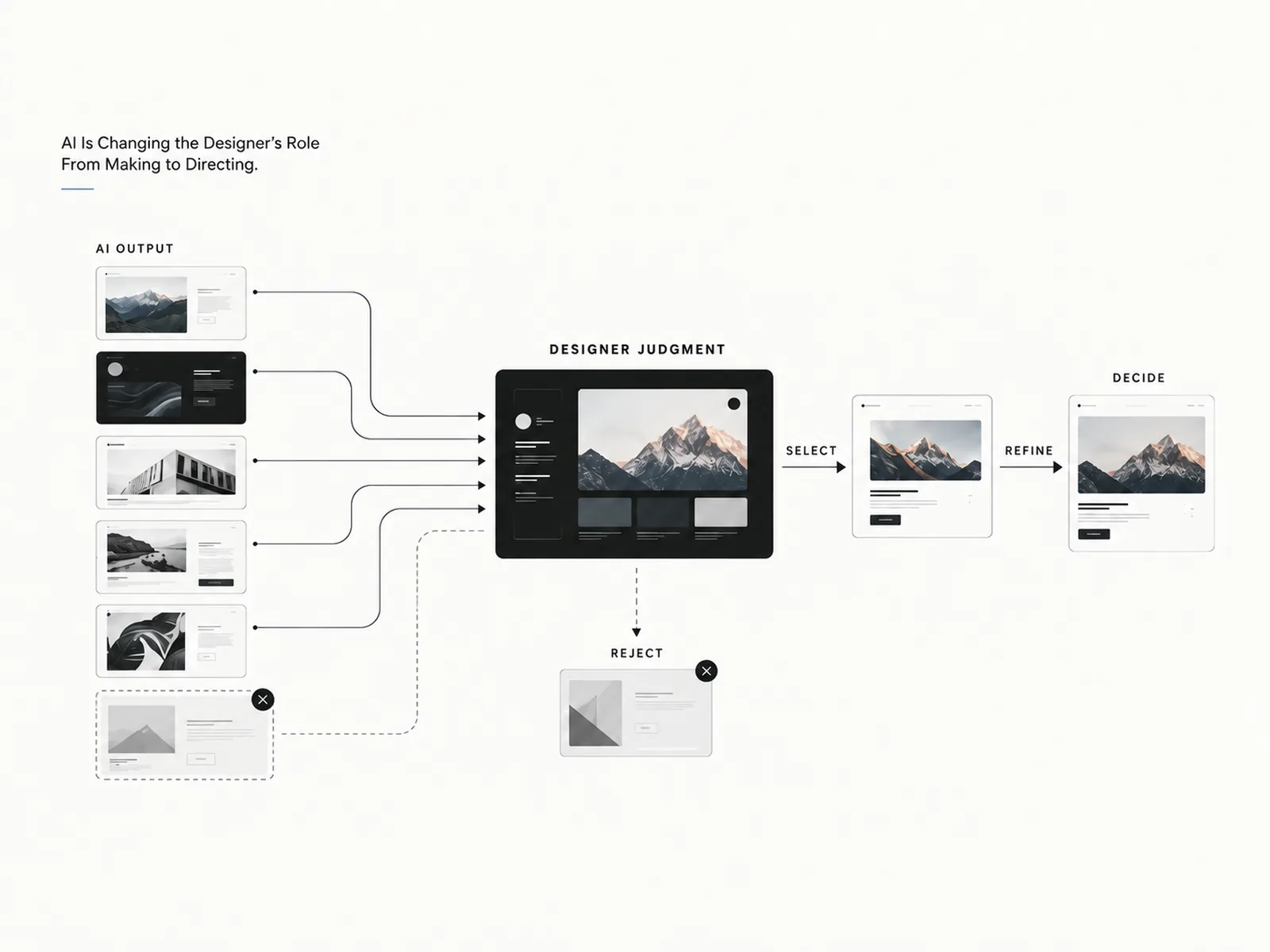
AI can generate usable design output quickly. The designer’s job is shifting toward framing the problem, checking the result and deciding what is actually safe and useful enough to ship.
AI makes design output faster to produce, but speed shifts more responsibility toward framing, validation and judgment. The designer still has to control scope, challenge assumptions and decide what is safe and useful enough to ship.
JUMP TO
Producing more options is easier. Deciding what deserves to ship is not.
AI has already changed one obvious part of design work: producing options is faster.
Before design, I spent years in operational planning where decisions had to be made while information was incomplete, delayed or changing. A fast answer was useful, but only if you understood what it was based on, what could be wrong and what happened when the normal flow failed. I find myself applying the same logic to AI-assisted design.
I can now explore layouts faster, generate copy alternatives, test directions and move from a rough idea to something tangible with much less production work. I have no reason to protect the repetitive part of the job just because designers used to spend hours doing it manually.
The interesting question starts when generation becomes cheap.
If producing ten options takes minutes, producing ten options is no longer much of an advantage.
Knowing which one deserves to survive is.
That moves more of the work away from execution and toward judgment. What problem are we actually solving? Which constraint matters? What did the generated solution assume without telling us? Does it still work outside the happy path?
A polished result can make those questions easier to ignore. That is one of the risks of AI-generated design. The output can look finished before the thinking is finished.
Good spacing, clean typography and familiar patterns create credibility very quickly.
Credibility is not correctness.
For me, that is where the role starts moving from making toward directing.
A polished output can still be wrong.
The original version of this article described the shift as execution becoming validation. I still think that is the right distinction. AI can accelerate production, but someone still needs to decide whether the output belongs in the product.
I do not see validation as a final QA step.
It starts much earlier.
AI can produce information that sounds confident and is simply wrong. It can reproduce bias from the data and patterns behind it. Those problems become much more serious once generated output moves from concept work into real products.
The visual quality of the interface does not protect you.
Imagine a generated onboarding flow with the wrong eligibility condition. Or a support experience that gives the wrong next action. The screen may look completely professional.
The product is still wrong.
I care about that distinction because real systems rarely operate under perfect conditions. Data arrives late. Services fail. Different users may be acting on the same information at the same time. A design that works only while everything behaves exactly as expected is not finished.
AI makes it easier to generate the normal state.
The harder design work is often everything around it.
What happens when the answer is uncertain? What happens when two parts of the system disagree? What can the user safely do next?
Those are design decisions. Generating the interface does not remove them.
The skill is controlling the work, not generating more of it.
I do not think the important new skill is prompting.
Prompting is useful. Direction is broader.
When I direct AI-assisted work, I need to know what the system is allowed to change and what has to remain stable. I need to recognise when the output technically satisfies the request but solves the wrong problem.
Sometimes the next step is another prompt. Sometimes I edit the result myself. Sometimes the right decision is to throw it away.
That is why I am less interested in measuring AI workflows by how much they generate.
I care more about how well the workflow controls change.
Suppose I ask AI to improve one page in a product and it changes a shared component used by four others. The requested page may look better. The system may now be worse.
The problem is not generation quality.
It is scope.
The same applies to UX flows. An AI-generated checkout can look convincing while completely ignoring payment failure, missing account data or recovery after an interrupted session.
Making the prompt longer will not automatically solve that.
Someone has to understand the product well enough to know which questions are missing.
That is direction.
It is also why hard constraints matter. In real products, add another option is often not a solution. The system already has technical constraints, business rules, accessibility requirements, dependencies and states that cannot simply be designed away.
AI can explore inside that space.
The designer still has to define the space.
DESIGN VALUE = DIRECTION + JUDGMENT + VALIDATIONResponsibility does not move to the tool.
The Medium version called this emerging role an AI Design Strategist. I understand the idea behind that label, but I am less interested in creating another job title now. The underlying change matters more.
Designers are going to work with systems that produce larger parts of the output.
Responsibility does not move with the output.
If AI generates a component, I still own the decision to use it. If it proposes a flow, I still own the logic I accept. If it writes convincing copy that makes the wrong promise, the user does not care whether the sentence came from a model.
It shipped in the product.
That makes judgment more valuable, not less.
Technical execution still matters. Craft still matters. I do not want every interface to collapse into the same competent AI-generated template.
But production ability alone will become easier to access.
Recognising why a solution works is harder.
Recognising when it breaks something elsewhere is harder still.
The designer I want on an AI-assisted product is not necessarily the person who can produce the most screens in one afternoon.
I want the person who knows when to stop generating.
And can explain why the result is ready, or why it is not.
CLOSING SIGNAL
I do not think AI turns designers into managers of machines. The job is still design. What changes is where more of the effort goes. I may spend less time manually producing every variation. I will spend more time setting boundaries, checking assumptions, reviewing consequences and deciding what belongs in the product. That is not a smaller role. AI can shorten the distance between an idea and a plausible result. It cannot remove responsibility for the result. And the faster output becomes, the easier it is to ship something before anyone has really challenged it. For me, that is the important shift from making to directing. I do not need to personally create every pixel. I still need to own the decision.